Once across
Getting data across the border
Updated 6 September 2026
Roaming on your Hong Kong SIM is the least hassle for the odd afternoon in Shenzhen, a mainland eSIM works out cheaper if you're crossing every week, and either way you'll need a VPN if you want WhatsApp or Gmail to keep working once you're through the checkpoint.
None of this is complicated, but it trips people up because Hong Kong's network genuinely stops at the border. Your phone doesn't just "have signal" on the other side unless you've told it what to do first. Here's what actually works, what it costs, and what still won't load no matter what SIM is in the tray.
Roaming with the SIM you already have
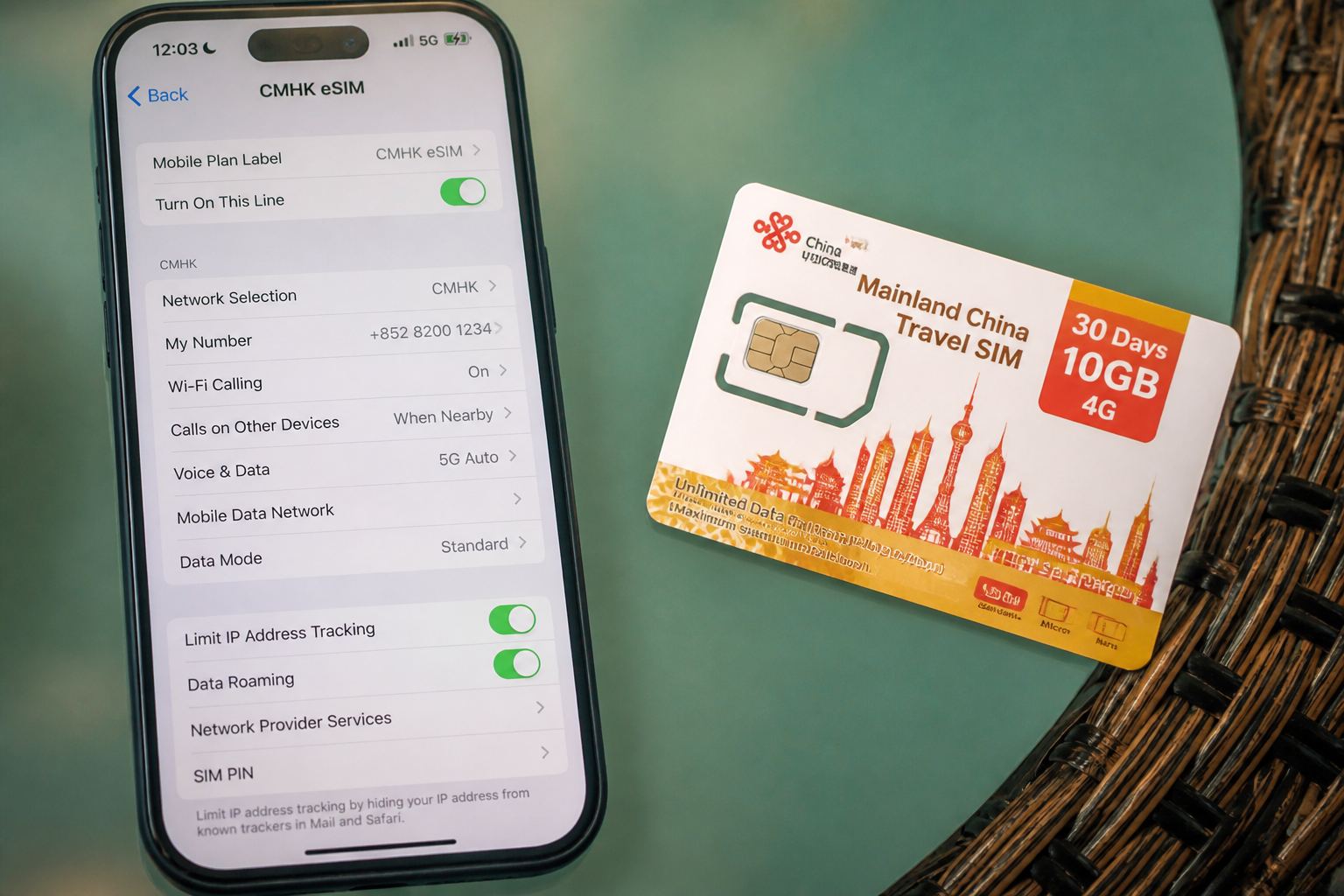
The simplest option is to leave your HK SIM in and let it roam onto a mainland network the moment you cross. CMHK is the most straightforward of the four Hong Kong operators here: its Data Roaming Zone product caps your daily spend in mainland China and Macau at around HK$48, so you use data as normal and the meter just stops running once you hit that ceiling for the day. No pass to remember to buy in advance.
SmarTone sells multi-day roaming data packs rather than a pure daily cap, with APAC bundles running from roughly HK$138 for four days up to HK$480 for fifteen days, so it suits someone doing a long weekend rather than a single trip to Luohu. I couldn't pin down current published day-pass figures for 3 HK or csl specifically for mainland China, they change these periodically, so check the roaming section of your carrier's app before you leave rather than trusting a number you read somewhere online, mine included.
Whichever operator you're on, roaming eats battery and can lag behind a local connection, especially inside crowded spots like Luohu Commercial City. If you're timing a crossing around a specific port's hours, it's worth checking which border crossing to use first, since some routes get you into a stronger signal area faster than others.
Getting a mainland eSIM before you go
If you're over the border most weeks, a standing mainland data eSIM is the better economics. China Unicom's Hong Kong arm (CUniq) sells eSIM products bundling Mainland China, Hong Kong and Macau data together, and third-party eSIM marketplaces list similar Shenzhen and Greater Bay Area plans you can install from your phone in a few minutes. The appeal is you install it once, it sits in a second eSIM slot alongside your existing HK number, and you just switch the active data line when you cross rather than buying anything fresh each trip.
Exact current pricing on these varies by data volume and validity period, and changes often enough that I'd rather send you to check the live price in the CUniq store or your eSIM app than quote you a number that's stale by the time you read this. Budget for it being cheap relative to roaming if you're a regular crosser, that part holds.
This is also the setup that makes sense if your regular Shenzhen trips involve a proper shopping run, say a stock-up at one of the Sam's Club stores in Shenzhen, where you'll want maps and price-checking apps working reliably the whole time you're in the warehouse, not just intermittently.
Buying a physical SIM in Shenzhen
You can also just buy a mainland SIM once you're there, from a China Mobile, China Unicom or China Telecom shop, or at Bao'an airport if you're flying in. All mainland SIMs require real-name registration, meaning you hand over your passport, staff photograph it, and the SIM gets tied to your identity on the spot. It's not optional and it's not fast at busy branches, so don't plan this for the ten minutes between crossing the border and catching a bus.
Typical pricing for a short-term tourist SIM sits somewhere in the CNY 80 to 200 range for a week to a month of data, though I'd treat that as a rough band rather than a quote. The obvious downside is that it's a second physical SIM, so unless you've got a dual-SIM phone, your Hong Kong number goes dark until you swap back.
| Option | Rough cost | Keeps your HK number live | Best for |
|---|---|---|---|
| Roam on your HK SIM (CMHK, csl, 3, SmarTone) | CMHK capped near HK$48/day; others sell multi-day packs | Yes, it's the same SIM | Occasional day trips |
| Mainland/Bay Area eSIM installed ahead of time | Varies by data and validity, check current price before buying | Yes, if your phone supports a second eSIM | Weekly or more frequent crossers |
| Physical mainland SIM bought locally | Roughly CNY 80 to 200 for a week to a month | Only with a second phone or dual-SIM slot | Longer stays, or if you're out of other options |
The firewall doesn't care whose SIM you're on
Here's the part people get wrong: it's not your Hong Kong SIM that keeps WhatsApp or Google working, it's Hong Kong's network. The moment your data session hands off to a mainland tower in Shenzhen, whether you're roaming on CMHK or running a fresh China Unicom eSIM, you're on mainland infrastructure and the Great Firewall applies to that connection regardless of who's billing you for it. WhatsApp, Gmail, Google Maps, Instagram and YouTube will all stop loading, and no amount of switching SIMs fixes that.
A VPN is the only workaround, and it's worth setting one up and testing it from Hong Kong before you cross, since you generally can't download a new VPN app once you're already on the mainland side.
The good news is that most things Hong Kong people actually rely on day to day aren't touched by any of this. Your banking apps, the Octopus app, MTR Mobile, government login portals, none of it sits on the blocked list, so it keeps working on mainland data without a VPN. The apps that vanish are specifically the Western platforms the firewall targets, not "Hong Kong" apps as a category.
Once your data's sorted and you're not staring at a spinning wheel every time you open a map, the next thing worth nailing down before you cross is how you're actually going to pay for anything, which is its own small maze of Octopus limits and app quirks covered in the guide to paying in Shenzhen as a Hong Kong resident.
Quick answers
- Will my Hong Kong number keep receiving SMS?
- Often yes on roaming. Check your operator. Wallets sometimes want a code.
- Is Wi-Fi in the hall enough?
- Not once you are looking for a taxi rank in the rain.
Hours, fares, and rules move. Check ImmD, C&ED, or the operator the morning you travel.