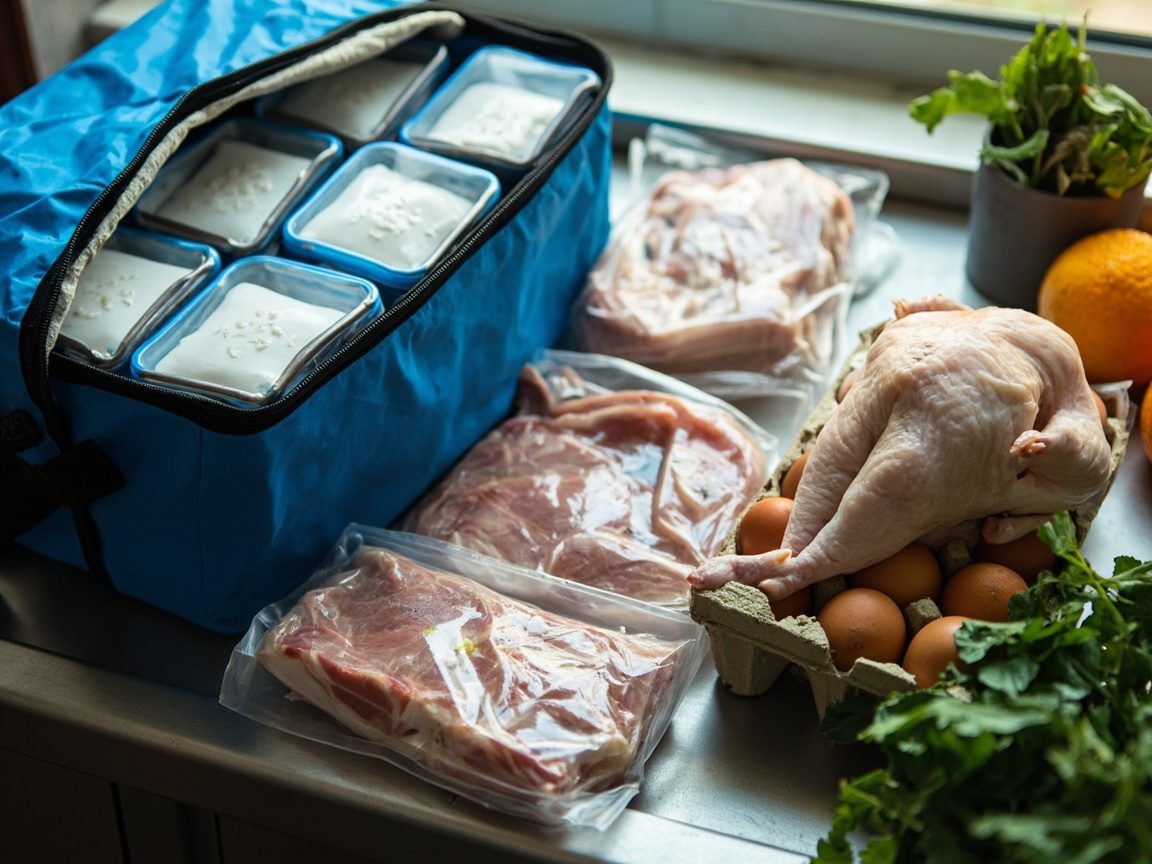
The shop and the bags
Can you bring meat, eggs and fresh food back from Shenzhen?
Updated 28 September 2026
Every Sam's Club run ends at the freezer aisle, and every freezer aisle raises the same question: can this come home? For the pork, the chicken and the eggs, the answer under Hong Kong law is no, unless you have paperwork that no shop gives you at the till. The rules are old, but the enforcement is not: prosecutions have multiplied since the border reopened, and the government restated the position in the Legislative Council in June 2026. This page sets out what the law says, what is genuinely allowed, and what the fines look like.
For duty-free alcohol and tobacco, the cash declaration and the rest of the Customs list, start with our guide to what you can bring back. This page is only about food, and mostly about the fridge.
What does the law say about meat, poultry and eggs?
The rule is the Imported Game, Meat, Poultry and Eggs Regulations, Cap. 132AK. The Centre for Food Safety (CFS) sums it up in its 13 February 2026 reminder: each consignment of game, meat, poultry and eggs, "whether for personal use or not", must come with a health certificate from the place of origin or written permission from the Food and Environmental Hygiene Department (FEHD).
For food from the Mainland, the certificate has a specific meaning. It is issued by Mainland Customs, and it proves the food comes from processing plants registered to supply Hong Kong. That is a trade document for registered exporters. A Sam's Club receipt, a butcher's bag with the shop's name on it, or a vacuum seal with a date stamp is not a certificate.
There is a second law on top. Under the Import and Export Ordinance, Cap. 60, each consignment of meat and poultry also needs an import licence, although Customs' controlled imports page says no licence is needed for up to 15 kg of frozen or chilled meat and poultry in your personal baggage, for your own consumption or as gifts. That exemption covers the licence only: the Cap. 132AK health certificate is still required. The CFS import FAQ puts the maximum penalty for importing chilled or frozen meat and poultry without a licence at HK$500,000 and two years in prison. Under Cap. 132AK the maximum is HK$50,000 and six months.
"Game" is wider than it sounds. The CFS defines it as the fresh or frozen flesh or edible parts, offal included, of animals other than cattle, sheep, pigs, chickens, ducks, geese and turkeys, and gives deer, crocodile and pigeon as examples. So a roast pigeon's raw cousin from a Shenzhen wet market is covered too.
There is no personal-use allowance for the certificate. Unlike alcohol and tobacco, which come with a set duty-free quantity, there is no amount of raw chicken that the law treats as small enough to ignore.
Does vacuum-packed, frozen or blanched meat count?
Yes, all three. This is where most people get caught, because the advice at the shop counter is often wrong.
- Vacuum-packed and foil-wrapped. The CFS says raw meat in any form of packaging, "including vacuum packed or tinfoil", is controlled. In a 2024 LegCo reply the government said vacuum-packed meat, poultry and eggs "will not be exempted". Packing changes nothing about the rule.
- Frozen. Frozen is still raw. The CFS FAQ lists frozen meat alongside vacuum and foil as regulated.
- Blanched or partly cooked. In a written reply to LegCo on 17 June 2026, the government addressed claims by some Mainland meat stalls that meat can pass the border once it has been blanched. Its answer: bringing in game, meat or poultry that has not been thoroughly cooked, "e.g. partially cooked or blanched", without the documents is an offence, and the CFS has intercepted such cases "with successful convictions".
The same logic applies to eggs. The CFS's current import FAQ names hot spring eggs as an example of a partially cooked product that is still regulated, and it says preserved (century) eggs and salted eggs are regulated too, needing both a health certificate and FEHD import permission, so leave the salted eggs in Shenzhen too. Fully cooked eggs, such as braised eggs, are not covered by Cap. 132AK.
What food can you bring back without paperwork?
Most of the trolley. Customs' passenger FAQ says travellers carrying fruit, vegetables, fully cooked meat and seafood, hairy crab included, in their personal baggage "in a reasonable quantity" for their own use are generally not subject to control. The practical list:
| Food | Can it come back? | The source |
|---|---|---|
| Raw, chilled or frozen pork, beef, lamb | No, not without a certificate, plus a licence over 15 kg | Cap. 132AK and Cap. 60 |
| Raw or frozen chicken, duck, goose | No, not without a certificate, plus a licence over 15 kg | Cap. 132AK and Cap. 60 |
| Blanched or half-cooked meat | No | LegCo reply, 17 June 2026 |
| Raw eggs, soft-boiled eggs | No, not without a certificate or permission | Cap. 132AK, CFS FAQ |
| Fully cooked meat, such as roast duck or a rotisserie chicken | Generally yes, reasonable personal quantity | C&ED passenger FAQ |
| Dumplings, wonton and other compounded food | Yes, no certificate needed | CFS FAQ |
| Seafood, including hairy crab | Generally yes, reasonable personal quantity | C&ED passenger FAQ |
| Fruit and vegetables | Yes, no plant licence needed | C&ED FAQ, AFCD |
| Rice | Yes, up to 15 kg for your own use or as gifts | C&ED passenger FAQ |
| Milk, milk drinks, ice cream | Controlled: check with the FEHD first | C&ED FAQ, CFS |
Two of those lines need a word of explanation.
Dumplings and wonton. The CFS FAQ says compounded food like dumplings and wonton is not regulated under Cap. 60 or Cap. 132AK, so it does not need a certificate, licence or permission. The general rule that all food must be fit to eat still applies.
Fruit and vegetables. The Agriculture, Fisheries and Conservation Department's plant import page says no plant import licence or phytosanitary certificate is needed for cut flowers, or for fruit and vegetables for consumption, and it lists plants from mainland China among its exemptions. A bag of lychees or a box of oranges is fine.
Baked mooncakes, with or without a salted yolk, are fully cooked and sealed, so the "not thoroughly cooked" rule for eggs does not describe them. The same reading covers biscuits, cakes and the whole cakes Sam's Club sells.
What about milk, ice cream and frozen desserts?
These sit in a separate category. Customs lists milk and milk beverages among the foods under import control and tells travellers to consult the FEHD before bringing them in. The CFS's Food Safety Focus on cross-boundary groceries says FEHD approval is needed when importing frozen confections, milk or milk beverages "from a source of manufacture for sale".
The CFS's current import FAQ puts it the same way: importers need FEHD import permission for ice cream and other frozen confections, and for milk and milk beverages, when the food is for sale, and no FEHD application is needed to bring in other dairy such as cheese and yogurt. It also tells travellers to store dairy properly on the way, for example by carrying ice cream in chiller bags with ice packs. No official text we found says outright that a tub of ice cream or a carton of fresh milk for your own fridge needs no permission, and Customs still tells travellers to consult the FEHD, so we are not going to guess a personal-use rule. If dairy matters to your trip, ask the FEHD before you buy. For a day trip, the simpler answer is that Hong Kong supermarkets sell both, and neither survives a Sunday queue at Lo Wu well anyway.
How often do people get caught, and what is the fine?
More often every year. The June 2026 LegCo reply includes the CFS's own count of cases and prosecutions for bringing in game, meat or poultry, with eggs counted separately:
| Year | Cases | Prosecutions | Average fine | Highest fine |
|---|---|---|---|---|
| 2022 | 101 | 111 | HK$1,034 | HK$4,000 |
| 2023 | 620 | 658 | HK$1,184 | HK$8,000 |
| 2024 | 1,417 | 1,497 | HK$1,239 | HK$6,500 |
| 2025 | 1,542 | 1,631 | HK$1,282 | HK$12,000 |
| 2026 (January to May) | 637 | 664 | HK$1,424 | HK$6,000 |
Prosecutions exceed cases because one person carrying, say, both pork and pigeon can face a count for each category. In 2025 one case ended in a one-month prison sentence. The lowest fines have been between HK$100 and HK$300, but that is a court record, a trip to court, and a fine higher than the saving on most pork.
The first five months of 2026 already average about 127 cases a month, against about 128 a month over 2025. Holiday months tend to run higher: in 2025 the peaks were October to December, and the CFS hands out leaflets at the control points before Chinese New Year and other holidays. With Golden Week landing on 1 to 7 October, the holiday crossings page is worth reading alongside this one.
How they find it
The CFS has seven quarantine detector dogs, deployed at the land crossings, according to the 2026 reply. In 2022-23 they helped find 398 suspected cases. Customs uses X-ray and computed tomography scanners on baggage. In one four-day joint operation in June 2024 at Lo Wu, the Spur Line, Shenzhen Bay and Heung Yuen Wai, Customs and the CFS found 15 cases of raw meat, poultry and eggs. A cool bag full of vacuum packs is exactly what the dogs and the scanners are there for.
Walking through the Green Channel counts as telling Customs you have no controlled items. If you do have raw meat with you, the honest route is the Red Channel, where the officer will deal with it; the dishonest one is the one that ends in a prosecution.
Can you get a health certificate for your own shopping?
Realistically, no. The certificate the CFS asks for on Mainland food is issued by Mainland Customs for food from processing plants registered to supply Hong Kong. That system exists so licensed importers can bring in commercial shipments with an FEHD import licence, and it does not come with a supermarket shop. Written permission from the FEHD is the other route in law, but it is an application made in advance, not something you arrange on the way to the border.
The honest summary: buy your raw meat and eggs in Hong Kong, and spend the Shenzhen budget on the things that cross freely. The Sam's Club guide has the stores and routes; the rotisserie chicken, the cakes, the snacks and the household bulk all come home without a certificate.
What about buying through a cross-boundary agent?
Some people skip the trip and order Mainland meat through a buying agent who brings it over and hands it off at an MTR station or a pickup point. The 2026 LegCo reply says the import rules apply to purchases through agents too, and the agents can be prosecuted. It also warns buyers that this food can come from unknown sources and sit in poor storage or transport conditions. The CFS says it works with Customs on these cases, so the handover point is not a safe gap in the rule.
How to carry the food you are allowed to bring
The CFS's advice on cross-boundary groceries is about safety as much as law, and it is sound for a long day that ends in a queue:
- Keep raw and ready-to-eat apart. Use separate sealable, waterproof bags so juices from one do not reach the other.
- Keep it cold. An insulated bag with ice packs, packed last and opened least, holds up far better than a plastic carrier.
- Watch the clock on cooked food. Ready-to-eat food that sits between 4°C and 60°C after you buy it falls under what the CFS calls the 2-hour / 4-hour rule. A roast duck bought at lunch and carried through a Sunday queue can easily pass both marks, so buy cooked food last, not first.
- Fridge first at home. Unpack the chilled items before anything else.
- Read the labels. The CFS notes that some products show a manufacture date rather than the best before or use by date Hong Kong labelling requires, so work out the shelf life before you buy.
Space is the other limit. A cool bag is one more piece of luggage, and the coach operators count pieces; the luggage rules page has each operator's allowance. For medicines, which follow different rules again, see bringing medicine back from Shenzhen.
Key facts
- Cap. 132AK: game, meat, poultry and eggs need a health certificate or FEHD permission, personal use or not.
- From the Mainland: the certificate is issued by Mainland Customs for registered plants supplying Hong Kong.
- Maximum penalties: HK$50,000 and six months (Cap. 132AK); HK$500,000 and two years for chilled or frozen meat and poultry without an import licence (Cap. 60).
- Not exempt: vacuum-packed, foil-wrapped, frozen, blanched or partly cooked.
- Generally allowed: fully cooked meat, seafood, fruit, vegetables, dumplings and wonton; rice up to 15 kg.
- 2025: 1,542 cases and 1,631 prosecutions for game, meat and poultry; average fine HK$1,282.
- 17 June 2026: the government confirmed in LegCo that blanched meat is an offence without documents.
Quick answers
- Can I bring frozen meat from Sam's Club Shenzhen into Hong Kong?
- Not without a health certificate issued by Mainland Customs or written permission from the FEHD, and a supermarket receipt is neither. The Imported Game, Meat, Poultry and Eggs Regulations (Cap. 132AK) apply to every consignment, whether for personal use or not, and frozen or vacuum-packed meat is not exempt.
- Is blanched or half-cooked meat allowed through the border?
- No. The government told the Legislative Council on 17 June 2026 that bringing in game, meat or poultry that has not been thoroughly cooked, such as partially cooked or blanched meat, without the required documents is an offence, and that the Centre for Food Safety has secured convictions for it.
- Can I bring eggs back from Shenzhen?
- Not raw eggs, and not partially cooked ones such as soft-boiled eggs, unless they come with a health certificate or FEHD permission. Eggs are covered by Cap. 132AK in the same way as meat and poultry.
- What food can I bring back from Shenzhen without paperwork?
- Customs says fruit, vegetables, fully cooked meat and seafood, including hairy crab, in reasonable quantities for personal use are generally not subject to control. Compounded food such as dumplings and wonton does not need a certificate, and rice up to 15 kg in your luggage needs no licence.
- What is the fine for bringing raw meat into Hong Kong?
- The maximum under Cap. 132AK is HK$50,000 and six months in prison. In practice, fines in 2025 ranged from HK$150 to HK$12,000 and averaged HK$1,282, and one person was jailed for a month, according to government figures given to LegCo.
Rules and penalties change. Check the Centre for Food Safety, C&ED or the FEHD before you travel.