The crossing
Huanggang and Heung Yuen Wai
Updated 26 September 2026
Which of Hong Kong's two least-used crossings should you actually pick, Huanggang or Heung Yuen Wai? Take Huanggang when the clock has already beaten you, it's the only 24-hour port there is. Take Heung Yuen Wai when you're headed toward Longgang or Pingshan and don't want to burn half an hour doubling back through downtown Shenzhen first.
Both get skipped by first-timers because neither has its own MTR platform, and both feel like a faff next to walking straight off the East Rail Line at Lo Wu. Once you've used each a couple of times, though, they solve problems the other three crossings can't.
Huanggang: open all night, but you'll never step off a train there
Huanggang runs 24 hours a day, full stop. It's the only one of the five crossings that never shuts, which makes it the default answer for anyone crossing between midnight and half six in the morning, when Lo Wu, the Spur Line to Futian, Shenzhen Bay and Heung Yuen Wai are all closed. Our late-night crossing guide has every closing time, the last trains and the overnight minibuses home.
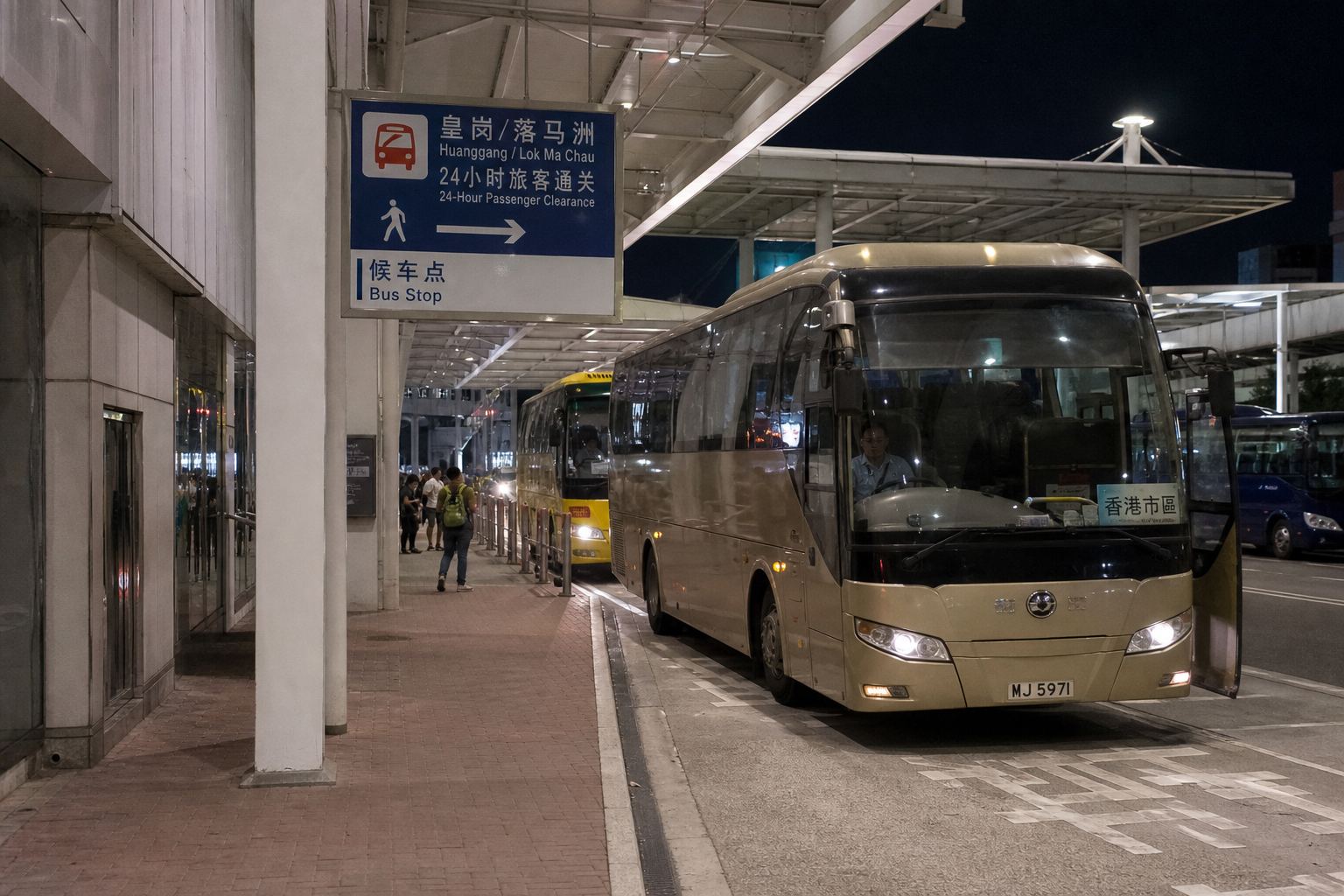
Here's what trips people up: Huanggang's Hong Kong-side building is the Lok Ma Chau Control Point, a different building from the MTR-connected Lok Ma Chau Spur Line station nearby, which actually faces Futian. There's no train to Huanggang. You reach the Lok Ma Chau Transport Interchange by bus, minibus, or cross-boundary coach, and once you've cleared Hong Kong immigration you still don't walk across the border. You board the Huang Bus, a dedicated shuttle that runs the short hop over the boundary bridge into the Shenzhen terminal, for HK$10. It runs every 5 to 15 minutes during the day and drops to roughly every 10 to 15 minutes overnight, so you're never waiting long even at 3am.
Getting to Lok Ma Chau in the first place is the actual decision. Minibus 616S runs from Mong Kok (Sai Yeung Choi South Street) to the Lok Ma Chau Control Station for around $25 (seniors on Octopus pay $2), taking about 45 minutes and covering the overnight window when little else does. If you'd rather not change buses at all, several operators run through-coaches straight from Mong Kok, Wan Chai, Kwun Tong, and Tsuen Wan into Shenzhen via Huanggang without you getting off, for roughly $45 to $63 depending on where you board. The payoff on the Shenzhen side is real: Huanggang Checkpoint station sits directly on Shenzhen Metro Line 7, right at the port building, so there's no onward bus or taxi needed to get moving.
One thing to watch: the rebuilt Huanggang Port, with both sides' immigration in one building and no shuttle bus, is finished but not yet open. As of 18 September 2026 the government says it opens in the fourth quarter of 2026, and The Standard reports a target of 12 October. It comes with seven franchised bus routes and six minibus routes of its own. Until it opens, the Lok Ma Chau Control Point and the Huang Bus above are still how Huanggang works. Our new Huanggang Port guide covers the one-queue lanes, the routes and the opening date.
Heung Yuen Wai: the newest port, and by far the quietest
Heung Yuen Wai, which faces Liantang on the Shenzhen side, is the youngest of the five crossings and it shows. Queues here are consistently shorter than at Lo Wu or Futian, partly because it sits out by Sha Tau Kok and Man Kam To, away from where most cross-border traffic naturally flows, and ImmD lists its hours as 7:00 am to 10:00 pm.
Citybus route B7 is the main link, running between Sheung Shui (Po Wan Road) and the port via Fanling MTR station along the Heung Yuen Wai Highway. Section fares are $11.3 or $6.4 depending on where you board, and if you tap the same Octopus or e-payment card for both legs on the same day, the return trip drops to a concessionary $8.5. Citybus B8, and KMB's B9 and B9A, fill out the rest, covering Shatin via Tai Po and Tuen Mun via Yuen Long, so you're not necessarily starting from Sheung Shui or Fanling at all. I couldn't confirm which number matches which corridor, so check the route board at the stop rather than trust a guess. Route 59S is a further option from Sheung Shui station, section fare around $9.9.
On the Shenzhen side, Liantang Port station connects to Metro Line 2 (an extension that folds in what was built as Line 8), with exits A2 and A3 dropping you right at the port. That's genuinely useful if Longgang or Pingshan is where you're going: entering here keeps you on the eastern side of the city instead of putting you through Luohu or Futian first and then dragging you back east across town. I couldn't pin down a single-transfer route from Liantang into central Longgang, so budget for at least one line change, but geographically this port does you a favour that Lo Wu or Shenzhen Bay never will.
| Port | Hours | HK-side access | Typical fare in | Best for |
|---|---|---|---|---|
| Huanggang | 24 hours | Bus/coach to Lok Ma Chau, then Huang Bus ($10) across the bridge, no MTR | $10 shuttle, or $45 to $63 on a through-coach from town | Late-night and early-morning crossings when nothing else is open |
| Heung Yuen Wai | 07:00 to 22:00 | Citybus B7 from Fanling/Sheung Shui, or KMB routes from Tuen Mun/Sha Tin | $6.4 to $11.3 one way, $8.5 same-day return on B7 | Longgang and Pingshan trips, and avoiding queues generally |
If you're not sure any of this beats your usual crossing, it's worth running your specific trip through the border crossing picker, which filters all five by hours, crowding, and where you're actually headed on the other side. And whichever port you land at, don't assume your Octopus works once you're through immigration; the payments guide covers what actually taps and scans on the mainland side these days. One thing these two ports won't do is get you conveniently close to a Sam's Club run, since all three stores sit well west of both of them; for that trip, start from the Sam's Club hub page instead and pick a western crossing.
The rule that sums up both ports: Huanggang solves the clock, since it's the only one open around the clock, and Heung Yuen Wai solves the queue, since it's consistently the shortest one going. Pick based on which problem your trip actually has, and the choice makes itself.
Quick answers
- Can I take the MTR to Huanggang?
- No. It is a road crossing. Shuttle and coaches.
- Is Heung Yuen Wai 6:30 like Lo Wu?
- ImmD currently lists 7:00 am to 10:00 pm. Check before you go.
Hours, fares, and rules move. Check ImmD, C&ED, or the operator the morning you travel.