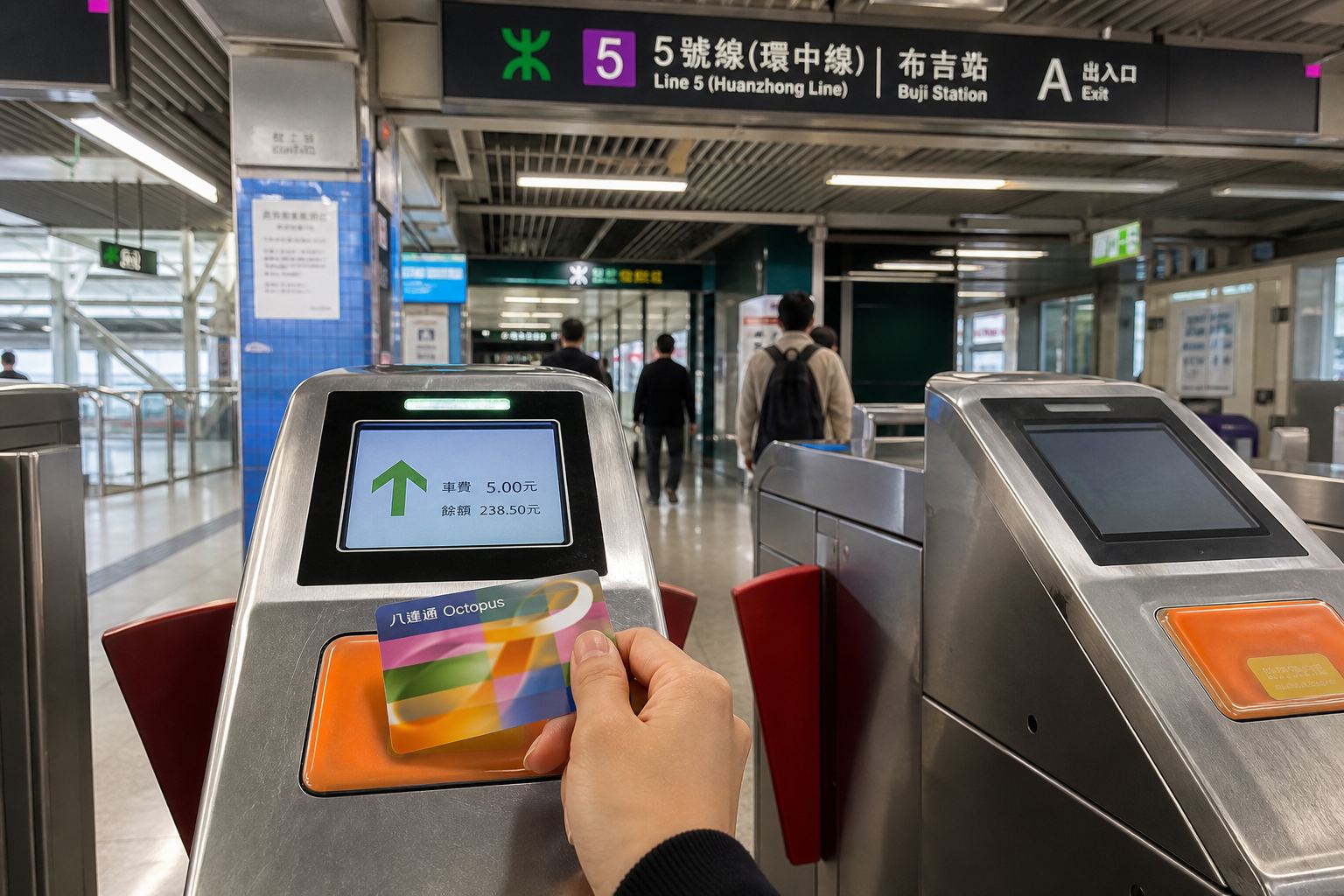
Once across
Octopus in Shenzhen
Updated 28 September 2026
Before you get to the border, flip your Octopus card over. If there's no small "T-Union" mark printed on the plastic, that card is dead weight once you're through the gates on the Shenzhen side. It'll still tap you onto the MTR on the way home, but it won't touch a bus, a metro gate, or a shop till in the mainland.
The short answer
A normal Hong Kong Octopus card, the one in your wallet right now, doesn't work in Shenzhen. Not on the metro, not on buses, and definitely not at a till. There's exactly one exception, and it's narrower than most people assume: a separate Octopus product built on the China T-Union network, and it only covers public transport.
Everything else, groceries, restaurants, a taxi from Futian to Bao'an, needs a different tool entirely. That's the part most Hong Kong residents get wrong the first few times, so it's worth being precise about what each card actually does.
The T-Union Octopus: transit only, and it's a different card
The Octopus, China T-Union card is a physical card you buy separately from your daily commuter Octopus. It costs HK$42, comes with no stored value and no deposit, and you'll find it at selected MTR customer service centres, any 7-Eleven or Circle K, China Travel Service outlets, or the Octopus online shop. You top it up through the Octopus app (which works fine while you're already in the mainland) or through cash reload at the usual Hong Kong spots.
Once it's loaded, it taps onto Shenzhen Metro gates exactly like a local Shenzhen Tong card, and it's accepted on public transport in a claimed 336 mainland cities, Shenzhen among them, converting your Hong Kong dollars to renminbi automatically at a rate stored on the card. That rate has a shelf life of 365 days and needs refreshing, or the card stops working on the mainland side until you do. The rate also carries Octopus's cross-border fee: Octopus's FAQ says it has been 1% since 5 March 2025, until further notice, and you only get the 1% once you've refreshed the card's rate by topping up or through the app. It's a transit card, full stop. Don't expect it to buy you a coffee.
You may not need it for the metro, though. From 10 September 2026, Shenzhen Metro says every gate at all 432 stations on its 17 lines accepts contactless UnionPay, Visa, Mastercard, American Express and JCB cards, or a phone linked to one, as long as contactless and small-amount no-PIN payment are switched on. If the metro is all you need, a contactless Hong Kong bank card now does the job. The notice doesn't mention fees, so check your bank's foreign currency charge.
The Shenzhen-Hong Kong dual-wallet card
There's a second, less well known option: a joint card called 互通行, or Hu Tong Xing, issued together by Octopus and Shenzhen Tong. It's really two separate purses fused onto one piece of plastic, an Octopus HKD wallet for Hong Kong and a Shenzhen Tong RMB wallet for the mainland side, each read by that city's own system. It costs RMB 68 a card, according to Shenzhen Tong, again with no stored value or deposit included, and the catch is you can only buy it in Shenzhen, not in Hong Kong. It's unregistered, so it can't be reported lost. Near the border, Shenzhen Tong lists the self-service card machines at Futian Checkpoint, Luohu and Huanggang Checkpoint metro stations, and the customer service centre at Futian Checkpoint station, among the places to buy it.
You top up the Hong Kong side the normal Octopus way, through the app or at reload points here. The Shenzhen side gets loaded through Shenzhen Tong's own channels once you're over there: metro station customer service centres, Shenzhen Tong outlets and self-service machines, or NFC top-up in the Shenzhen Tong app. The RMB wallet is a Shenzhen Tong purse that also meets the national T-Union standard, so Shenzhen Tong says it works on Shenzhen buses, metro and trams and on public transport in 336 T-Union cities, but it's still fundamentally a transit-and-limited-retail tool, not a general payment card.
| Card | Price | Buy it in | Covers |
|---|---|---|---|
| Standard HK Octopus | n/a (yours already) | Hong Kong | Hong Kong only |
| Octopus, China T-Union | HK$42 | Hong Kong (MTR centres, 7-Eleven, Circle K, CTS) | Transit in 336 mainland cities incl. Shenzhen, plus HK |
| Hu Tong Xing dual wallet | RMB 68 | Shenzhen only | HK Octopus network plus Shenzhen transit and some retail, and transit in 336 T-Union cities |
Why shops won't take it
The mismatch isn't really about Octopus being unwelcome, it's that mainland tills are built around WeChat Pay and Alipay QR codes, plus UnionPay, and Octopus's closed-loop stored-value system was never wired into that. There's a partial workaround worth knowing about: since December 2024, the Octopus app (the phone app, not the physical card) lets you scan a WeChat Pay QR code at a mainland merchant and pay out of your Octopus HKD balance, which Octopus says now reaches millions of mainland merchants. It's genuinely useful in a pinch, but it's app-based scan-and-pay, not the tap-and-go your physical card does, and fee waivers that applied when it launched won't necessarily last forever. These payments run through the app's Octopus UnionPay card, and Octopus's FAQ lists a 1% foreign currency transaction fee on it, shown as waived only until 30 June 2026.
For the wider picture on what actually works at Shenzhen checkouts, from card-based UnionPay to app wallets, our payments guide for Hong Kong residents lays out the full set rather than just the Octopus corner of it.
What to actually carry
For day to day spending, WeChat Pay HK and Alipay HK are the ones doing the real work now. Both now work broadly across Shenzhen merchants, including taxis, with access that expanded significantly from December 2024 onward, and neither needs you to hold a mainland bank account. Load one or both before you go, and you're covered for everything from a noodle stall to a supermarket trolley run. If that trolley run is at one of the Sam's Club branches, our Sam's Club from Hong Kong hub covers which store, what it takes to get in, and how people are actually paying at the till there.
Getting across the border in the first place is a separate question from what's in your wallet, but the two often collide when you're timing a trip. If you're not sure which crossing suits your route or your patience for queues, the border crossing tool filters all five by hours and crowding, useful whether you're heading through Lo Wu, the Lok Ma Chau Spur Line into Futian, or Shenzhen Bay.
What's likely to still be true
Your everyday Octopus card taps onto Shenzhen transit only through the separate T-Union or Hu Tong Xing products, and it doesn't work at mainland shops or taxis at all. WeChat Pay HK and Alipay HK are what merchants there actually accept.
Quick answers
- Can I tap into a convenience store?
- Do not plan on it.
- Is there a dual-purse card?
- Hu Tong Xing is a Shenzhen product, sold only in Shenzhen at RMB 68 a card, according to Shenzhen Tong.
Hours, fares, and rules move. Check ImmD, C&ED, or the operator the morning you travel.