Once across
Getting around by metro
Updated 9 November 2026
You pay with your phone or, since 10 September 2026, a contactless international bank card. For the phone, open WeChat or Alipay, generate a transit QR code, and scan it at the gate the same way you'd scan to pay in a shop. Either habit gets you onto every line you'll need for a border crossing or a Sam's Club run.
WeChat and Alipay transit codes replace Octopus
Forget Octopus. Unless you're carrying an Octopus China T-Union Card or a Hu Tong Xing dual-purse card (see our Octopus page), tapping an ordinary Octopus at a Shenzhen Metro gate does nothing. What works, reliably, is the transit code inside WeChat or Alipay: search for the "乘车码" mini-program (or just look for the transport icon on the home screen), complete any real-name check the app asks for, and a QR code generates on demand. Hold it over the scanner going in, hold it again going out. The fare gets worked out automatically from the distance you travelled.
There's now a second option: your own bank card. Since 10 September 2026, every gate on all 17 lines and 432 stations accepts contactless UnionPay, Visa, Mastercard, American Express and JCB cards issued outside the mainland, according to a Shenzhen Metro release. Tap the card, or a phone with the card bound to it, at the gate. It only works if the card supports contactless payment and has small-amount no-PIN payment switched on. The system converts the currency and deducts the fare automatically. The release says nothing about fees, so check your card issuer's foreign-currency charges.
If your phone dies or the app misbehaves, ask station staff how to buy a paper ticket; we could not confirm which payments the ticket machines take. Secondary sources mention a 24-hour tourist pass at about 25 yuan, which we could not confirm on Shenzhen Metro's own page, so check the price before you rely on it. For the fuller picture on getting WeChat Pay HK or Alipay HK set up before you cross, the payments guide covers it in more detail than makes sense to repeat here.
The lines that actually matter for a border run
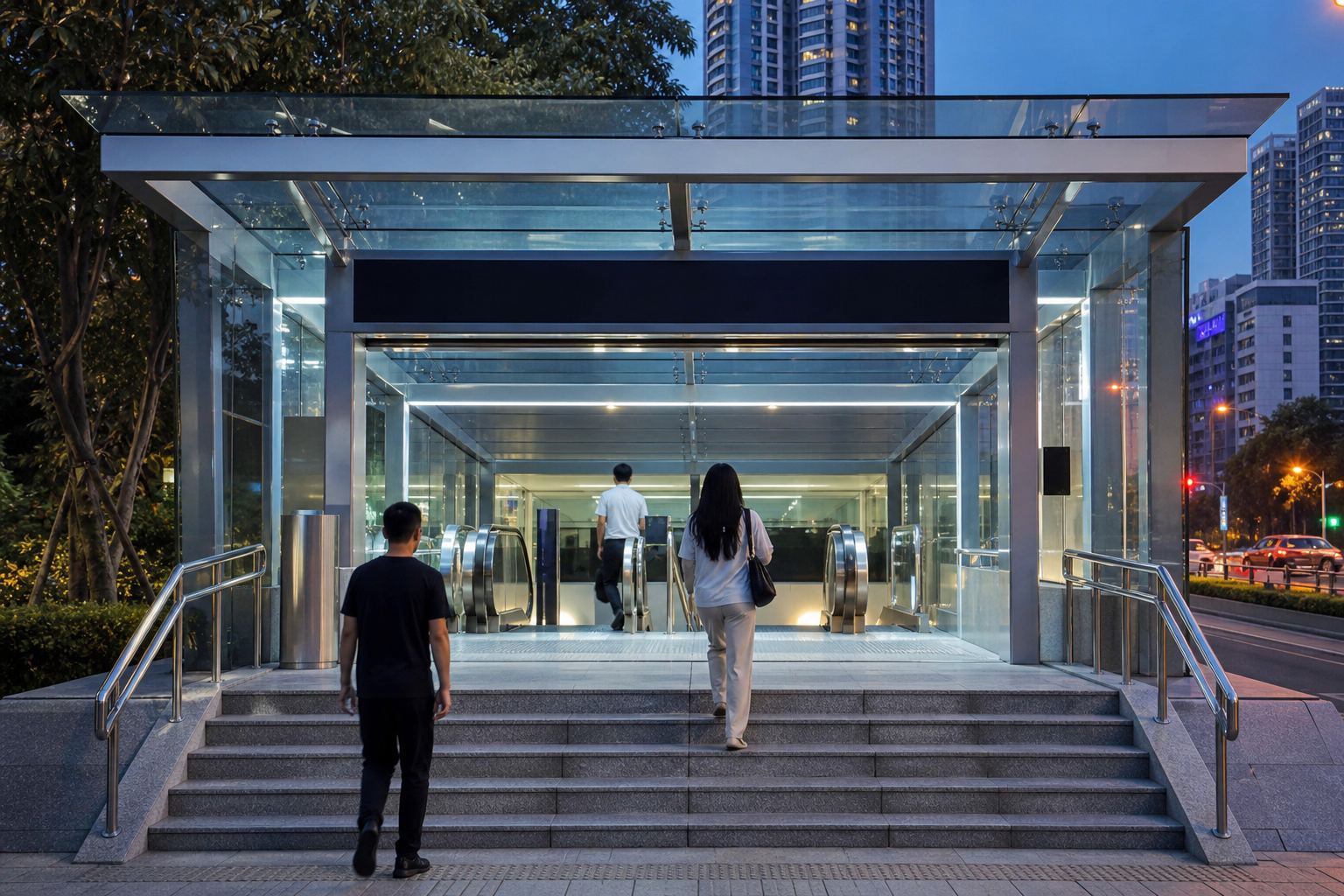
You don't need to learn all of Shenzhen's metro map, just the handful of lines that touch the crossings you'll actually use. Luohu station, at the bottom of Line 1, sits right against Lo Wu. Futian Checkpoint station, where you come out after the Lok Ma Chau Spur Line, is served by both Line 4 and Line 10, though it is an out-of-station interchange between them, so you exit and walk around rather than switching platforms the way you would on the MTR. Huanggang, the only 24-hour Shenzhen land crossing as of 9 November 2026, is the new Huanggang Port, which press reports say connects directly to Shenzhen Metro Line 7. We could not confirm the station name on a primary page, so check it in the Shenzhen Metro app before you go. Shenzhen Bay Checkpoint station only opened in December 2024, on Line 13, and it's still the southern end of that line, so don't be surprised if your map app shows it as a dead end.
| Crossing | Metro line | Station | Crossing hours |
|---|---|---|---|
| Lo Wu / Luohu | Line 1 (Line 9 via an interchange at Renmin South) | Luohu | 06:30 to 24:00 |
| Lok Ma Chau Spur Line / Futian | Line 4 and Line 10 (no in-station transfer) | Futian Checkpoint | 06:30 to 22:30 |
| Huanggang | Line 7 | Huanggang (check the station name) | 24 hours, the only one |
| Shenzhen Bay | Line 13 | Shenzhen Bay Checkpoint | 06:30 to 24:00 |
| Heung Yuen Wai | No direct metro station; you'll need a bus or taxi to link up | - | 07:00 to 22:00 |
If you're not sure which of those five is worth the trip for what you're doing, the crossing picker filters them by hours, crowding and where you're actually headed, which is faster than trying to describe five different queueing patterns in prose.
Getting to the Sam's Club stores
Shenzhen has at least five Sam's Club stores, and the hub page covers how to reach the ones Hong Kong shoppers use. The Futian store is at 69 Nonglin Road; check the nearest metro exit in the Shenzhen Metro app, because published station names differ. We did not verify metro details for the Longhua and Bao'an stores.
What catches Hong Kong riders off guard
- Every station entrance has a bag scanner and sometimes a pat-down, airport-security style. It rarely takes long, but budget an extra minute or two, especially with a shopping trolley full of Sam's Club boxes.
- Tap-and-go with an international bank card is new here: it has worked at every gate only since 10 September 2026, and only if the card has small-amount no-PIN payment switched on. The QR code habit feels slower for your first few rides, then becomes automatic.
- Line changes aren't always a same-platform affair. Some interchanges (Futian Checkpoint being the obvious one) are out-of-station, so you leave the paid area and walk, which costs you a few minutes.
- Platform signage is mostly Simplified Chinese, which trips up some Hong Kong readers used to Traditional.
- Luohu and Futian Checkpoint get genuinely packed on Sunday evenings and public holidays, with queues that spill well past the gate line. If you can shift a Sam's Club trip to a weekday morning, do it.
One honest limitation here: fares are worked out by the metro's distance formula rather than posted as a fixed price per station pair, so any specific yuan amount for, say, Luohu to Qiaoxiang would be an estimate dressed up as a fact. Check the fare shown on your app before you tap in.
Quick answers
- English on the signs?
- Stations have bilingual names. Announcements vary.
- Airport from Futian?
- Metro exists. Count the time; do not cut ImmD's close.
Hours, fares, and rules move. Check ImmD, C&ED, or the operator the morning you travel.